


From Human-Level AI to Beyond Human Intelligence: The Critical Difference Between AGI and ASI
Image: Nil Taskin Digital Art
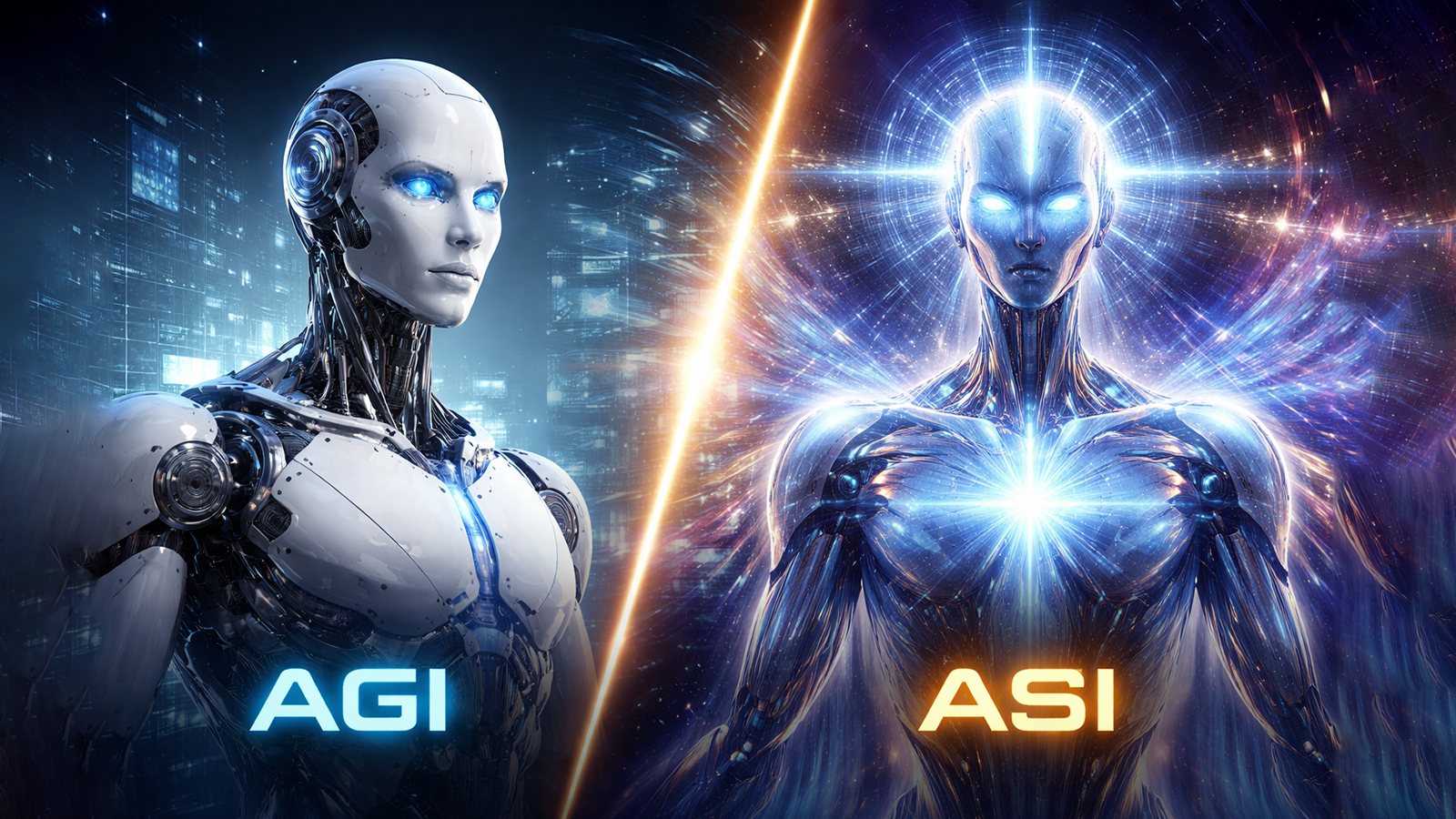
As artificial intelligence evolves, the conversation is no longer about whether machines can think—but how far that thinking might go. Two concepts dominate this frontier: Artificial General Intelligence (AGI), which aims to match human cognitive abilities, and Artificial Superintelligence (ASI), which would surpass them entirely. Though both remain theoretical, the gap between them represents one of the most consequential thresholds in technological history.
AGI would mark the moment machines reach human-level understanding across a wide range of tasks, from reasoning and creativity to decision-making. ASI, however, introduces a far more disruptive possibility: intelligence that operates beyond human comprehension, capable of reshaping science, economics, and global power structures at unprecedented speed. The distinction is not merely technical—it defines the difference between augmentation and transformation.
The difference between Artificial General Intelligence (AGI) and Artificial Superintelligence (ASI) primarily revolves around their capabilities and potential impact on human society. Here’s a breakdown:
1. Capability:
– AGI (Artificial General Intelligence): AGI refers to a machine’s ability to understand or learn any intellectual task that a human being can. It matches human capabilities, meaning it can perform equally well in tasks such as reasoning, problem-solving, and understanding complex ideas. AGI is essentially on par with human intelligence.
– ASI (Artificial Superintelligence): ASI goes a step beyond AGI by possessing intelligence that surpasses the brightest and most gifted human minds in practically every field, including scientific creativity, general wisdom, and social skills. ASI is not just at human level—it significantly exceeds it.
2. Development Stage:
– AGI: As of now, AGI remains a theoretical or aspirational level of artificial intelligence. Current AI technologies, such as machine learning and deep learning, are considered forms of narrow AI, which excel in specific tasks but do not possess general intelligence.
– ASI: ASI is also theoretical and would represent a future stage of AI development where systems can outperform humans in all areas. It is considered a potential future evolution of AGI.
3. Impact and Ethical Considerations:
– AGI: The development of AGI raises significant ethical and societal questions, such as employment impacts, privacy concerns, and decision-making in critical areas like medicine or law. Ensuring that AGI systems are aligned with human values is a key challenge.
– ASI: The implications of ASI are even more profound and potentially existential. ASI could lead to scenarios where AI systems make decisions at a level of complexity and speed incomprehensible to humans. Issues include the potential for ASI to operate with or without human control, and its impact could range from solving global challenges like climate change and disease to posing new, unprecedented risks.
In summary, while AGI and ASI both represent stages of AI development, AGI is about achieving human-level capabilities, and ASI is about exceeding those capabilities to an extreme extent, potentially leading to transformative changes in human civilization.
Nil Taskin