


Have We Finally Found a Cancer Vaccine? What Moderna’s Breakthrough Really Means
Image: Nil Taskin Digital Art
One of the biggest health and science stories of the week came from Moderna and Merck: their personalized mRNA cancer vaccine has delivered positive results in a late-stage clinical trial.
Some of the headlines, however, made it sound as though scientists had finally discovered the long-awaited “cancer vaccine.”
The reality is both more complicated — and, scientifically, perhaps even more interesting.
Cancer vaccines are not a new field of research. Universities, research centers and biotechnology companies around the world have been developing different types of cancer vaccines for years. Hundreds of cancer vaccine candidates have been evaluated clinically, while numerous trials involving technologies ranging from mRNA and neoantigen vaccines to dendritic-cell and viral-vector approaches are underway.
So Moderna’s announcement this week is important.
But not because it represents the discovery of the first cancer vaccine.
First, an Important Distinction: This Is Not a Conventional Vaccine Designed to Prevent Cancer
When people hear the term “cancer vaccine,” they may imagine something similar to a childhood vaccination: a vaccine given to healthy people to prevent them from developing the disease.
Most of the cancer vaccines currently being developed are different. They are therapeutic cancer vaccines.
Their purpose is to teach the immune system to recognize characteristics of an existing tumor — or of a tumor that has already been surgically removed — so immune cells can identify and destroy cancer cells that remain or later reappear.
We already have vaccines that can prevent certain cancers.
HPV vaccines dramatically reduce the risk of cervical cancer and several other cancers caused by human papillomavirus. The hepatitis B vaccine reduces the risk of liver cancer by preventing chronic HBV infection.
Those vaccines prevent infections that can eventually cause cancer.
The goal of the new generation of therapeutic cancer vaccines is fundamentally different: to direct the immune system against the cancer cells themselves.
What Exactly Does Moderna’s Vaccine Do?
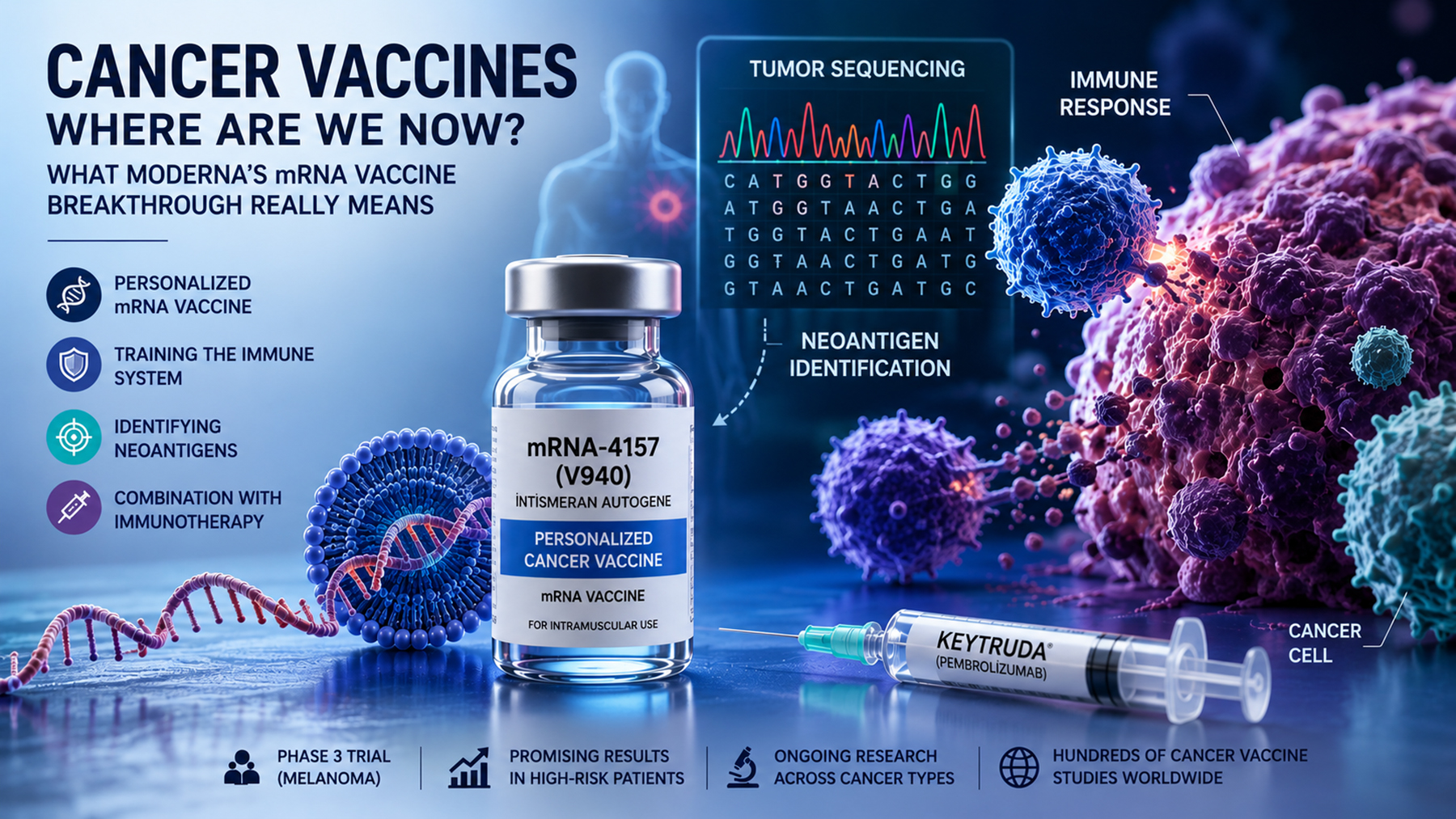
Moderna’s vaccine, developed in partnership with Merck, is called intismeran autogene (V940/mRNA-4157). It is a personalized mRNA cancer vaccine.
The word “personalized” is crucial.
A sample of the patient’s tumor is genetically sequenced. Researchers then identify mutations in the cancer cells that can produce abnormal protein fragments known as neoantigens — molecular features that may distinguish cancer cells from healthy cells.
A customized mRNA vaccine is then manufactured specifically for that patient.
Once administered, the vaccine is designed to teach the immune system, in simplified terms:
“If you see cells carrying these particular signals, attack them.”
This is therefore not a standard cancer vaccine that would simply be manufactured in millions of identical doses and given to everyone.
Two people with the same type of cancer could potentially receive vaccines containing different targets because the genetic characteristics of their tumors are different.
So What Was the Big News This Week?
More than 1,000 patients with high-risk melanoma participated in Moderna and Merck’s Phase 3 trial.
After their tumors were surgically removed, one group received Merck’s existing immunotherapy drug Keytruda (pembrolizumab), while another received Keytruda together with the personalized mRNA vaccine.
According to the companies’ initial announcement, the combination of the vaccine and Keytruda significantly reduced the risk of cancer recurrence or distant metastasis compared with Keytruda alone.
That is an important result.
More significantly, a personalized mRNA cancer vaccine has now succeeded in a large, randomized Phase 3 study — a major milestone for the field.
But there is an important caveat:
The full Phase 3 results have not yet been published.
The companies have announced that the trial met its primary endpoints, but we still need the detailed data to determine the magnitude of the benefit, how different patient subgroups responded and, importantly, whether the treatment ultimately improves overall survival.
So statements such as “the vaccine prevents cancer” or “we have found the cure for cancer” go far beyond what the evidence currently shows.
And For Now, We Are Talking About Melanoma
Another potentially misleading aspect of some headlines is the use of the broad phrase “cancer vaccine.”
The successful Phase 3 trial did not involve every type of cancer.
It involved melanoma, one of the most dangerous forms of skin cancer.
Melanoma may also have a biological advantage when it comes to this particular strategy. Melanoma tumors often carry large numbers of mutations, potentially creating more neoantigens that the immune system can learn to recognize.
We therefore cannot assume that a strategy that works in melanoma will automatically produce the same results in every other type of cancer.
Moderna and Merck, however, are not limiting the technology to melanoma. The same personalized vaccine platform is being investigated in other cancers, including lung, kidney and bladder cancers.
So this week’s result does not mean that we have developed a universal vaccine against cancer.
But it does provide some of the strongest evidence yet that personalized mRNA cancer vaccination can work in humans.
Moderna Is Far From Alone in This Race
It would also be misleading to associate the entire cancer vaccine field with Moderna.
BioNTech and Roche/Genentech, among many biotechnology companies and academic research groups, are developing personalized cancer vaccines of their own.
A scientific review published in 2026 identified 78 clinical trials involving personalized cancer vaccines. Other contemporary trackers following neoantigen-based cancer vaccines list more than 100 studies.
Even if we narrow the field specifically to mRNA cancer vaccines, dozens of clinical trials are underway.
And melanoma is far from the only target.
Different vaccine technologies are being investigated in lung, pancreatic, kidney, bladder, colorectal and prostate cancers, as well as brain tumors and several other malignancies.
In pancreatic cancer, for example, early studies of personalized mRNA vaccines have found long-lasting immune responses in some patients. Researchers are also testing various mRNA and nanoparticle-based vaccine strategies against extremely difficult-to-treat tumors such as glioblastoma.
In other words, there is no single “cancer vaccine race.”
There is a large research ecosystem attacking the same fundamental problem from multiple directions.
Why Are Cancer Vaccines So Difficult to Develop?
With an infectious disease such as COVID-19, the target is relatively straightforward: the immune system is being trained to recognize something foreign — a virus.
Cancer is fundamentally different.
Cancer cells originate from our own cells. That makes it much more difficult for the immune system to distinguish malignant cells from normal tissue.
There is another complication: “cancer” is not a single disease.
Breast cancer, pancreatic cancer, melanoma and lung cancer are biologically very different diseases. Even two tumors arising in the same organ can differ significantly at the molecular and genetic level.
And cancer continues to evolve.
The genetic characteristics of a tumor can change over time, particularly under pressure from treatment.
This is precisely why personalized neoantigen vaccines are so appealing.
Rather than searching for one universal target shared by every tumor, scientists can potentially target the unique mutations found in an individual patient’s cancer.
mRNA technology is particularly well suited to this approach because it allows vaccines containing customized genetic instructions to be designed and manufactured comparatively quickly.
Are We Entering the Era of Cancer Vaccines?
It is still too early to say.
The history of cancer vaccine research contains many promising laboratory discoveries and early clinical results that ultimately failed to translate into successful treatments.
The extraordinary success of vaccines against infectious diseases has not, so far, been replicated in cancer.
But something has changed during the past several years.
Scientists can sequence tumors faster and more accurately. Computational tools have improved the identification of potentially useful neoantigens. mRNA platforms provide a flexible way of manufacturing personalized vaccines. And perhaps most importantly, vaccines can now be combined with checkpoint inhibitors such as Keytruda, which remove some of the molecular brakes that prevent the immune system from attacking tumors effectively.
The Moderna-Merck Phase 3 result matters in this context.
It is not, by itself, “the cure for cancer.”
It is evidence that an idea scientists have pursued for years may finally be translating into meaningful results in a large clinical trial.
Less Miraculous Than the Headlines — But Scientifically More Important
Moderna’s announcement should neither be dismissed as hype nor presented as evidence that scientists have simply “found the cancer vaccine.”
Cancer vaccines have been studied for decades, and many different approaches are currently being investigated around the world.
The Moderna-Merck vaccine is not a universal vaccine capable of treating every cancer. For now, the successful Phase 3 trial concerns patients with high-risk melanoma whose tumors had been surgically removed, with the personalized vaccine administered alongside Keytruda.
We also still need to see the complete Phase 3 data and, eventually, the overall survival results.
But after all those caveats, something genuinely exciting remains:
Cancer vaccine research may have crossed one of the thresholds scientists have been trying to reach for years.
The most important part of this story is not one Moderna vaccine.
It is the growing evidence that scientists may be able to sequence an individual patient’s tumor, identify its unique vulnerabilities, manufacture a personalized vaccine and successfully teach that patient’s immune system to recognize the cancer.
If the success now being seen in melanoma can eventually be reproduced in lung, pancreatic, kidney, bladder and other cancers, what we currently call “experimental cancer vaccines” could become part of the standard toolkit of cancer treatment.
That possibility — rather than the idea that someone has suddenly “invented a cancer vaccine” — is what makes this week’s news genuinely significant.
Nil Taskin